
You have spent hours choosing fabrics, cutting precise pieces, and planning your quilt top. Now you need a sewing machine that can keep up with your vision, handle thick layers, and deliver consistent stitches. The best rated sewing machines for quilting combine durability, stitch variety, and ease of use, whether you are piecing blocks or adding free-motion quilting.
In this guide, we have evaluated top models from Brother, SINGER, and SewLaVie to help you find the right companion for your quilting projects. From beginner-friendly options to advanced computerized machines, we cover what matters most: stitch quality, workspace, and special features like drop feed for free-motion work. For more inspiration, check out our best sewing machine for crafts guide as well.


Buying Guide for Quilting Sewing Machines
Stitch Options and Versatility
Quilting requires a variety of stitches, from straight and zigzag for piecing to decorative stitches for embellishment. Look for machines with at least 30 built-in stitches, but ideally more. The Brother XR9550 Computerized Sewing and Quilting offers 165 stitches, while the SINGER® C7290Q Computerized Sewing & Quilting provides 417 stitch applications, giving you plenty of creative freedom.
Additionally, check for a one-step buttonhole feature and alphanumeric stitches if you like personalizing your quilts. Machines with adjustable stitch length and width allow you to adapt to different fabric weights, from lightweight cottons to heavy denim.
Workspace and Extension Table
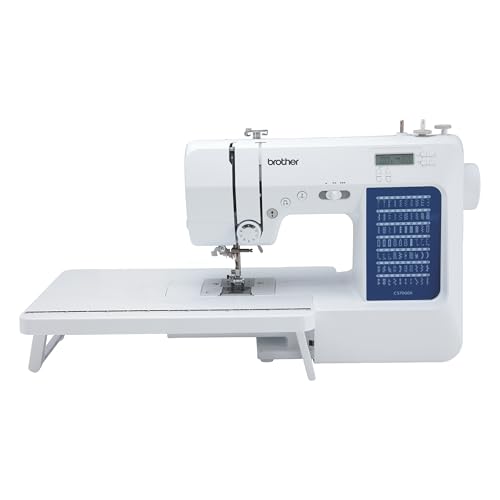
A quilting machine needs ample space to handle bulky quilts. A wide extension table provides extra support for large projects, preventing sagging and ensuring smooth fabric feeding. Many models, like the Brother XR3774 Sewing and Quilting Machine 37, include a wide table in the box.
Also consider the needle-to-arm space, which determines how much fabric you can fit to the right of the needle. A larger workspace is essential for free-motion quilting, as you need to move the fabric freely in all directions.
Free-Motion and Quilting Features
For free-motion quilting, you need a machine with a drop feed mechanism or a darning plate. This allows you to lower the feed dogs and move the fabric manually. The SewLaVie 996P Mechanical Sewing Machine with 36 features a drop-feed mechanism, making it suitable for free-motion and darning.
Some machines also offer a walking foot or even feed foot, which helps feed multiple layers evenly, preventing shifting and puckering. This is crucial for quilting with batting and backing.
Ease of Use and Convenience
As a quilter, you want to spend more time sewing and less time setting up. Look for features like an automatic needle threader, drop-in bobbin, and a bright LED light. A needle up/down function is a game-changer for pivoting corners and quilting curves.
For a comprehensive list of machines that excel in these areas, see our best size sewing machine needle for quilting guide, which pairs well with your machine choice.
Final Thoughts
After reviewing the top contenders, we recommend the Brother XR9550 Computerized Sewing and Quilting for its extensive stitch library and user-friendly features, perfect for quilters who want versatility and reliability. For those who prioritize heavy-duty performance, the SINGER® C7290Q Computerized Sewing & Quilting stands out with its 417 stitch applications and robust build. Both machines offer excellent value for quilters at any skill level.
Frequently Asked Questions
What is the best rated sewing machine for quilting for beginners?
For beginners, the Brother Sewing Machine, XM2701 is an excellent choice due to its 27 built-in stitches, automatic needle threader, and jam-resistant drop-in bobbin. It is lightweight and easy to learn, making it a popular pick for new quilters.
Do I need a computerized sewing machine for quilting?
Computerized machines offer precise stitch control, automatic features, and a wider variety of stitches, which can simplify quilting tasks. However, mechanical machines like the SewLaVie 996P are also capable, especially for free-motion quilting, if you prefer manual controls.
Can I use a regular sewing machine for quilting?
Yes, you can use a regular sewing machine for quilting, but machines with a wide table, drop feed, and adjustable stitch settings make the process easier. For more complex quilting, consider a machine with free-motion capability, as seen in our best sewing machine for sewing knits guide, which also applies to stretchy fabrics.
What is the best stitch length for quilting?
For piecing, a stitch length of 2.0 to 2.5 mm is typical. For free-motion quilting, a shorter stitch length (around 1.5 mm) works well, but you may need to adjust based on thread and fabric. Always test on a scrap piece first.